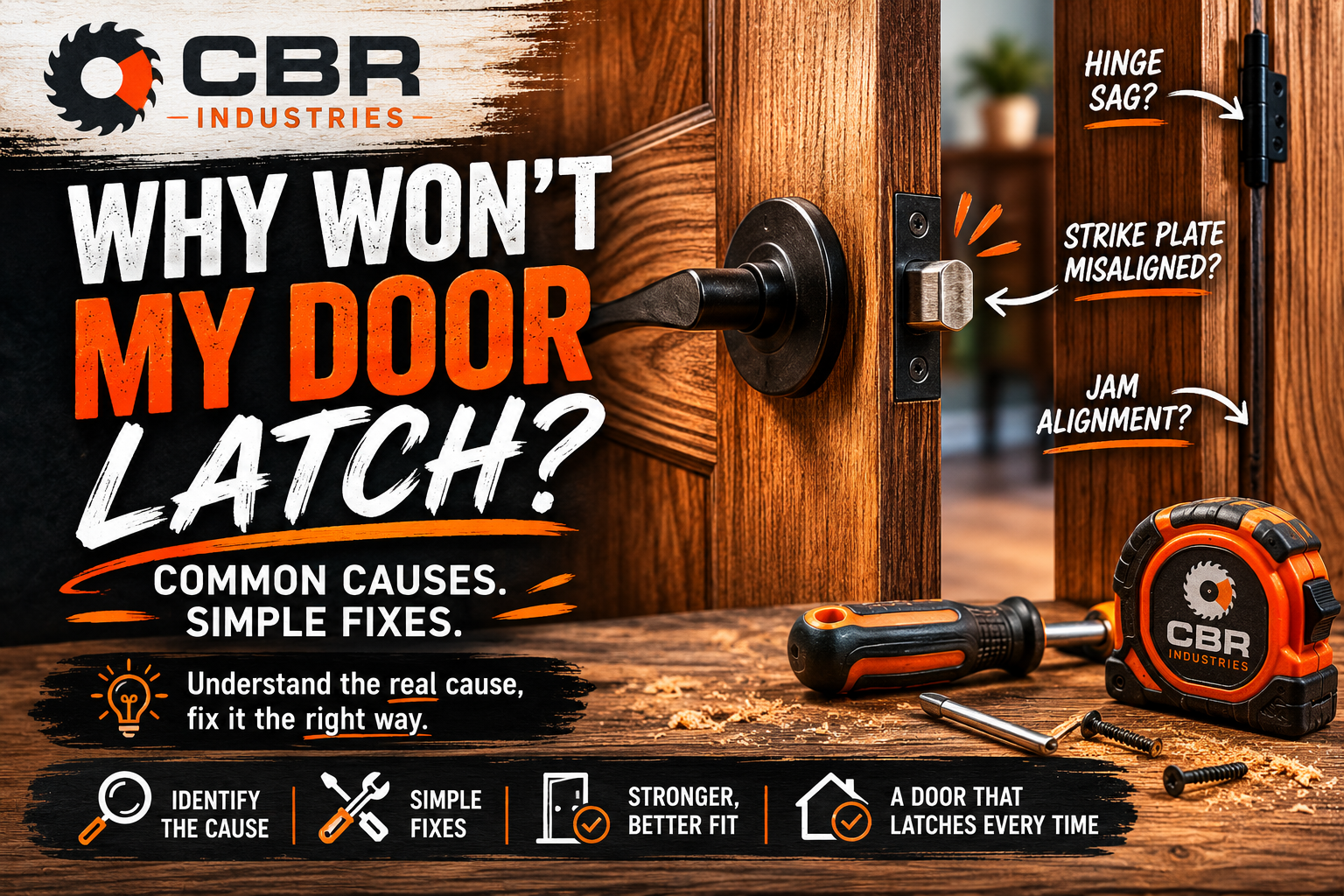
Why Won’t My Door Latch?
A Beginner's Guide to Understanding and Fixing Common Door Problems
You’re running late for school, work, or a family event. You pull the door shut behind you, hear it bounce back open, and suddenly you're standing there slamming it three more times hoping it magically fixes itself. Sound familiar?
Most people think a door that won't latch is a "door problem." In reality, it's usually a symptom of something else. Houses move. Wood expands and contracts. Hinges loosen. Floors settle. Before you know it, a door that worked perfectly for years starts rubbing, sticking, sagging, or refusing to latch altogether.
The good news? Most door latch problems can be diagnosed in just a few minutes once you understand how a door is supposed to work.
Today we're going to learn why doors stop latching, how to identify the real cause, and why adjusting the wrong thing often makes the problem worse.
Understanding How a Door Latches
Before we can fix a door, we need to understand what is happening when it closes.
When you shut a door, the latch bolt extends from the edge of the door and slides into the opening in the strike plate attached to the door jamb.
If everything is aligned correctly:
The door swings freely.
The latch enters the strike plate smoothly.
The door stays closed without forcing it.
If any one of those parts moves out of position, the latch misses its target and the door won't stay shut.
Think of it like trying to put a key into a lock. If the lock moves even a small amount, the key suddenly doesn't fit.
The Four Most Common Reasons a Door Won't Latch
1. Loose Hinges
This is one of the most common problems and often the easiest to fix.
Every time a door opens and closes, weight is placed on the hinges. Over thousands of cycles, screws can begin loosening.
When this happens:
The door starts sagging.
The latch drops lower than the strike plate.
The latch no longer enters the opening correctly.
How to Check
Open the door halfway.
Grab the handle and gently lift upward.
If you feel movement or see the door shifting, loose hinges may be the culprit.
Look closely at the screws. If any are backing out or spinning freely, they need attention.
Why It Happens
Interior doors may weigh 30 to 70 pounds.
Exterior doors can weigh much more.
All of that weight hangs from a few screws.
Eventually something gives.
2. Hinge Sag
Hinge sag is different from loose hinges.
Sometimes the screws are tight but the weight of the door has slowly pulled the frame out of alignment over time.
Signs include:
Uneven gaps around the door.
The top corner opposite the hinges rubbing.
The latch sitting low compared to the strike plate.
Quick Test
Stand back and look at the gap around the entire door.
The reveal—the visible gap between the door and frame—should be fairly even.
If one side is noticeably larger or smaller, the door may be sagging.
3. Strike Plate Misalignment
The strike plate is often blamed first because it's easy to see.
However, many homeowners immediately start filing or moving the strike plate before understanding why it became misaligned.
That's where problems begin.
If the latch suddenly doesn't line up anymore, something likely moved first.
The strike plate is often just showing you the symptom.
Signs of Misalignment
Look for fresh scratches on the strike plate.
These marks reveal where the latch is hitting.
You may notice:
Hitting above the opening.
Hitting below the opening.
Hitting one side.
Those marks are valuable clues.
4. Seasonal Movement
Wood is constantly changing size based on humidity.
In many parts of the country, doors fit differently in summer than they do in winter.
As moisture levels change:
Doors swell.
Frames expand.
Gaps become tighter.
This is especially common with exterior doors.
A door that latches perfectly in January may rub badly in July.
The Biggest Mistake Homeowners Make
The most common mistake is adjusting the wrong thing first.
Imagine a door is sagging because a hinge screw has loosened.
Instead of fixing the hinge, someone moves the strike plate lower.
The door now latches again.
Problem solved?
Not really.
The door is still sagging.
The hinge is still loose.
The issue continues getting worse until:
The door rubs.
The latch sticks.
The frame begins wearing unevenly.
What started as a simple screw repair becomes a larger project.
Always identify the cause before changing hardware.
A Simple Diagnostic Process
Professional carpenters rarely guess.
Instead, they follow a process.
Step 1: Check the Hinges
Inspect every screw.
Tighten anything loose.
Look for movement.
Step 2: Check the Reveal
Look at the gap around the entire door.
An uneven reveal usually points to alignment issues.
Step 3: Find Contact Points
Look for rub marks.
The door will usually tell you exactly where the problem is.
Step 4: Watch the Latch
Slowly close the door.
Observe where the latch contacts the strike plate.
This often reveals the issue immediately.
Step 5: Determine the Cause
Only after identifying the cause should you make adjustments.
When a Strike Plate Adjustment Makes Sense
Sometimes the strike plate really is the problem.
This can happen when:
New weatherstripping is installed.
A house settles.
Previous repairs changed alignment slightly.
Small adjustments can be effective.
However, strike plate modifications should generally be the last step after confirming the hinges and frame are in good condition.
What Professional Carpenters Look For
Experienced carpenters rarely focus on the latch first.
Instead, they ask:
Is the door square?
Is the frame square?
Are the hinges secure?
Is the reveal consistent?
Where is the weight of the door being transferred?
Once those questions are answered, the solution becomes much easier to find.
The latch is usually just the messenger.
My Thoughts
Doors are one of the most used moving parts in a home. A family can open and close the same door thousands of times every year. Over time, even a well-installed door can drift slightly out of alignment.
The next time a door won't latch, don't immediately reach for a file, screwdriver, or hammer. Take a few minutes to investigate what changed.
The best carpenters aren't the ones who know the fastest fix.
They're the ones who understand why the problem happened in the first place.
And once you learn that skill, you'll start looking at every door in a completely different way.