Best Cordless Power Tools for Beginner Carpenters
Getting started in carpentry, one of the first questions people ask is what tools they should buy. This is based on real jobsite experience, not just specs or opinions.
What brands should you look at?
Most of the main brands will get the job done. I’ve used Milwaukee, DeWalt, and Makita quite a bit, along with some time on Ryobi and Bosch.
At a basic level, they all work. The difference doesn’t really show up until you’re using them every day.
Right now I run mostly Milwaukee and DeWalt. That comes down to access and convenience. When you’re working consistently, it matters how easy it is to get batteries, replace tools, or grab something you’re missing without slowing down.
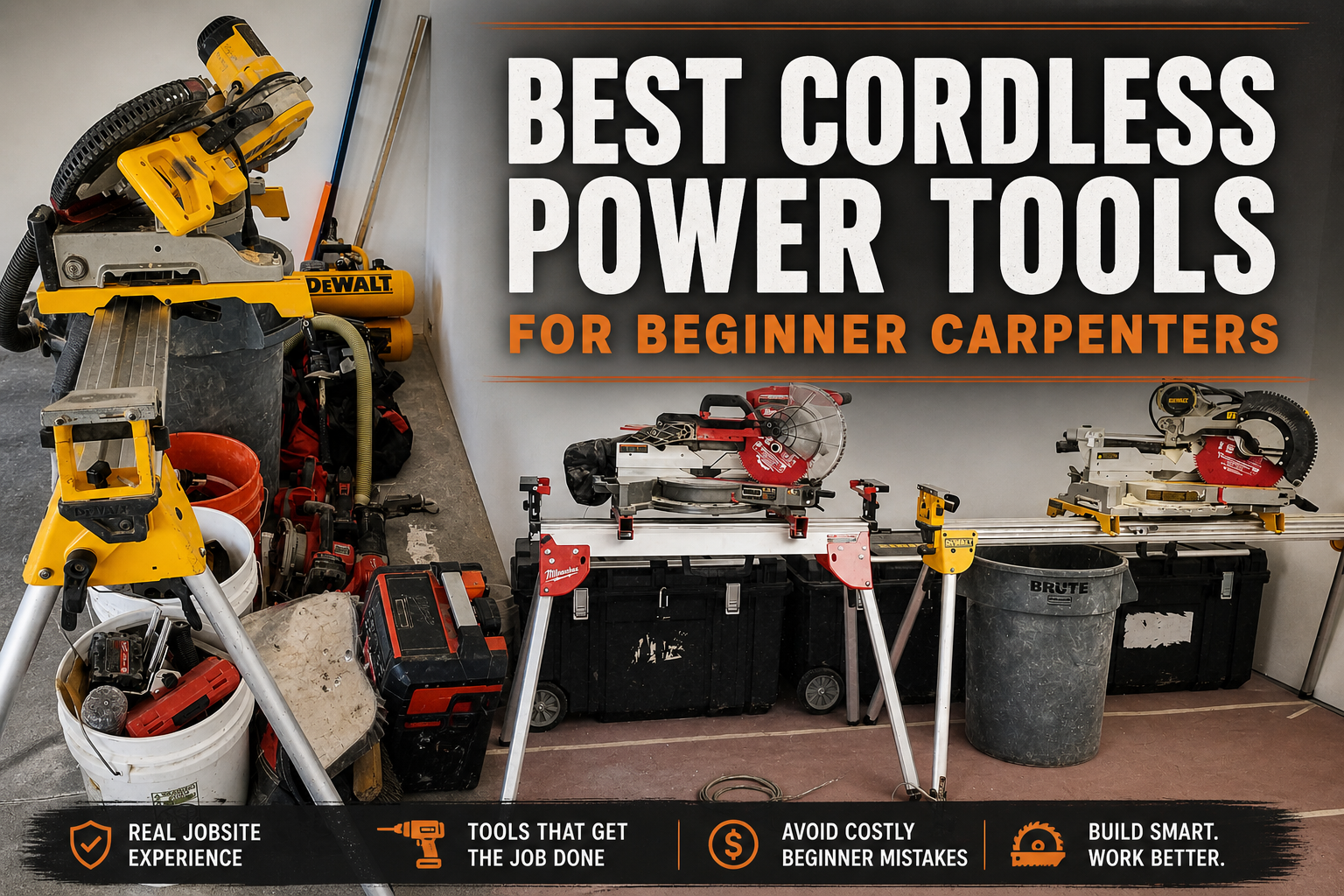
I’ve switched brands depending on the tool. Chop saws are a good example. I’ve used DeWalt, Milwaukee, and Makita, both corded and cordless.
The biggest difference wasn’t power, it was comfort and speed.
When you’re making a few cuts, everything feels the same. When you’re making hundreds or close to a thousand cuts in a day, small differences start to matter. How the saw feels, how smooth it runs, and how easy it is to move and reset.
For someone starting out, don’t chase the best brand. Pick a solid platform and stick with it.
What tools should you actually buy first?
It depends on the work you’re doing, but there are a few tools you’ll use on almost every job.
First is an impact drill. That’s not optional. You’ll use it constantly.
Next is a miter saw and a table saw. Those are some of the most used tools on a jobsite, especially for trim work and anything that needs to be clean and repeatable.
A cordless nail gun is another big one. It speeds everything up and keeps your work cleaner without dragging hoses and compressors around.
After that, it depends on your work. If you’re doing demo or cutting larger material, a skill saw and a sawzall come into play.
You can get through a lot with just those tools. You don’t need everything right away.
What mistakes do beginners make?
The biggest mistake I see is buying cheap tool kits without thinking long term.
They work at first, but when something breaks or a battery dies, you can’t easily replace it. You end up waiting on parts or trying to track things down, and that slows everything down.
With bigger brands, you can walk into almost any store and get what you need the same day. If you’re using your tools to make money, that matters.
Another mistake is not committing to a battery platform.
I’ve dealt with this myself. Having tools on different systems means you’re buying more batteries just to keep everything running. Batteries aren’t cheap, and it adds up fast.
At this point, every tool I buy fits into the same system so I can use what I already have.
Should you go cordless or corded?
Corded tools are going to be cheaper, and you can usually find good deals on them secondhand. That’s not a bad way to start if you’re trying to save money.
You can also find solid deals on cordless kits if you time it right. Around Christmas and Father’s Day, a lot of the bigger brands run promotions.
I still run corded tools on jobsites, especially compressors. There’s nothing wrong with corded tools.
If I had consistent power, I’d still be running a corded miter saw and table saw without any issue.
The reason I moved to cordless is because of jobsite conditions.
A lot of the time, you’re dealing with temporary power, limited outlets, or multiple trades all pulling off the same circuit. That leads to tripping breakers, running extension cords everywhere, and wasting time just trying to keep things running.
Cordless removes that problem. You can work without stopping and move faster.
For a beginner, corded tools can be a good way to start. But if you’re planning to be on jobsites regularly, cordless becomes a practical decision.
How many batteries do you need?
This depends on the kind of work you’re doing and how much you want to invest.
For me, more batteries is always better, but that also means more cost.
At a basic level, you’ll be fine as long as you have one battery in the tool you’re using and one on the charger. That’s enough to keep you moving.
Once you start working more consistently, you’ll probably want more than that so you’re not thinking about charging.
Batteries also tie directly into your platform. If you’re spread across different brands, you end up spending more just to keep everything powered.
Start with what you need, then build from there.
If I had to start over
I’ve gone through a lot of tools and a lot of brands over the years. I’ve switched from DeWalt to Milwaukee to Makita and back again depending on what I was doing at the time.
If I had to start over, I’d simplify it and stick with what I know works.
For me, that would be a DeWalt miter saw and table saw, and Milwaukee for everything else.
A lot of my cordless setup came from catching good deals at the right time. If I didn’t get those deals on the battery powered miter saw and table saw, I’d still be running them corded without any issue.
You don’t have to chase cordless everything right away. Use what makes sense for your situation.
The biggest thing is finding tools that work with you and that you actually want to use. If you don’t like how a tool feels or how it runs, you’re not going to use it the way you should.
At the end of the day, consistency matters more than anything. Pick a solid setup, get used to it, and build from there instead of constantly switching.