What You’re Really Paying for When You Hire a Finish Carpenter in Salt Lake City
When people ask, “What does custom finish carpentry cost in Salt Lake City?”, the honest answer is not as simple as throwing out one number.
Finish carpentry can mean a lot of different things.
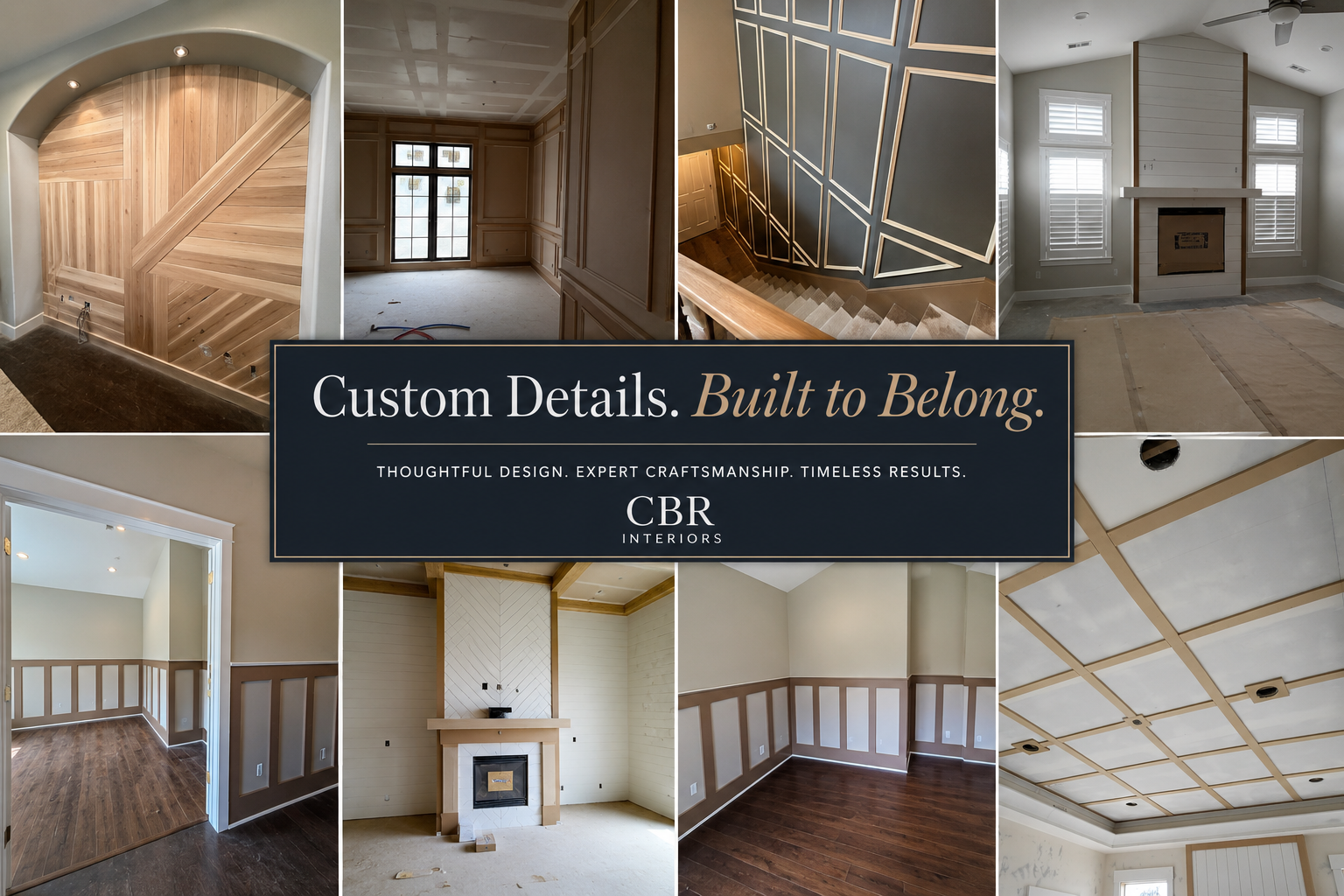
It can mean baseboards and casing. It can mean interior doors. It can mean crown molding, wall paneling, fireplace mantels, floating shelves, built-ins, stair rail, or a full custom feature wall. Those are not all the same job, and they should not all be priced the same way.
A basic baseboard install is different from laying out a detailed wall design. A simple mantel install is different from building a full fireplace surround. A floating shelf is different from a custom built-in. The more custom the work gets, the more the price comes down to layout, material, fit, finish, and how much detail you expect.
This article is meant to give homeowners in the Salt Lake Valley a better idea of what they are actually paying for when they hire a finish carpenter.
Not just the wood.
Not just the time.
The finished product.
Why Finish Carpentry Prices Vary So Much
The reason finish carpentry pricing changes so much is because the work changes so much.
Some jobs are straightforward. The walls are clean, the material is simple, the layout is basic, and the project moves fast.
Other jobs take more time because the house itself is not perfect. Walls can be out of square. Floors can be uneven. Drywall can be wavy. Corners are not always true. Framing is not always where it should be.
A good finish carpenter has to work with what is there and still make the final product look intentional.
That is where the price changes.
You are not just paying someone to nail wood to a wall. You are paying for:
Layout
Measuring
Cutting
Fitting
Adjusting
Problem-solving
Material handling
Clean installation
Consistent lines
Details that actually look right when the room is finished
That is also why two bids can be far apart.
One person might be pricing the fastest way to install something. Another person might be pricing the time it takes to make it look like it belongs in the home.
Those are not the same thing.
What a Finish Carpenter Actually Does
A finish carpenter works on the visible details of a home.
That can include:
Baseboards
Door casing
Window trim
Interior doors
Crown molding
Wall paneling
Shiplap
Accent walls
Fireplace mantels
Built-ins
Shelving
Floating shelves
Stair rail
Newel posts
Custom trim details
In a basic home, finish carpentry might mostly be base, case, doors, and shelving.
In a custom home or remodel, it can be much more detailed. That is where design, layout, proportion, and clean execution start to matter more.
This is the work that can take a plain room and make it feel finished. It can also take a good house and make it feel cheap if it is done poorly.
People may not always know the exact name of what is wrong, but they can usually tell when something looks off.
Bad reveals, uneven lines, open miters, weak returns, poor layout, and trim that does not line up all show up in the final product.
What You Should Expect Before the Work Starts
Before a finish carpenter gives a serious price, they should understand what is actually being built.
For a better estimate, the homeowner should be ready with:
Photos of the space
Rough measurements
Inspiration photos
The type of material wanted
Whether the work is paint-grade or stain-grade
Whether old trim needs to be removed
Whether painting or staining is included
Whether the home is occupied
Whether the carpenter is supplying material
Any timeline expectations
For smaller jobs, photos and measurements can be enough to give a rough starting point.
For custom work, a walkthrough is usually better. Photos do not always show how bad the walls are, how the floor runs, what needs to be matched, or what small details are going to slow the job down.
A good carpenter should be asking questions before giving a final number.
If someone gives a firm price without knowing the details, either the price is going to change later or something important is probably being skipped.
What You Should Expect During the Install
Finish carpentry should not feel random.
You should expect the work to be laid out before everything gets nailed in place. You should expect clean lines, consistent spacing, and communication if something unexpected comes up.
For a good finish carpentry project, you should be looking for:
Straight layout lines
Clean miters
Proper fastening
Consistent reveals
Good transitions
Trim that fits the room
Material that makes sense for the project
A clean jobsite
Communication when there is a problem
This matters because finish carpentry is one of the last trades people see.
A crooked stud inside the wall might get hidden. A bad trim layout does not. It sits right in front of you every day.
That is why I look at finish work differently. It is not just about getting wood on the wall. It is about making the room look finished when you step back.
What Affects the Price Most
The biggest price drivers are usually not just the cost of material.
A lot of the cost is in the labor, layout, and detail.
Material choice
MDF, finger-jointed material, pine, plywood, poplar, alder, oak, and stain-grade hardwoods do not all cost the same.
Paint-grade material is usually more forgiving. Stain-grade work usually takes more time because every cut, joint, grain direction, and exposed detail matters more.
Design complexity
A simple wall panel is not the same as a detailed picture-frame wall.
The more boxes, corners, reveals, transitions, and layout decisions there are, the more time the project takes.
A flat wall is one thing. A stair wall, vaulted wall, multi-plane wall, or wall that has to line up with existing features is a different job.
Existing conditions
New construction and remodels are not always equal.
In an existing home, there may be old trim to remove, paint lines to deal with, drywall damage, uneven floors, furniture in the way, or finished areas that need protection.
That adds time.
Occupied homes
Working in a lived-in home usually takes longer than working in an empty house.
There is more setup, more cleanup, more protection, and more coordination.
That does not mean it is a problem. It just needs to be priced honestly.
Finish level
There is a difference between “installed” and “installed clean.”
Some people just want trim up. Others want the details tight.
The tighter the expectation, the more time the carpenter needs to spend getting it right.
Ballpark Finish Carpentry Costs in Salt Lake City
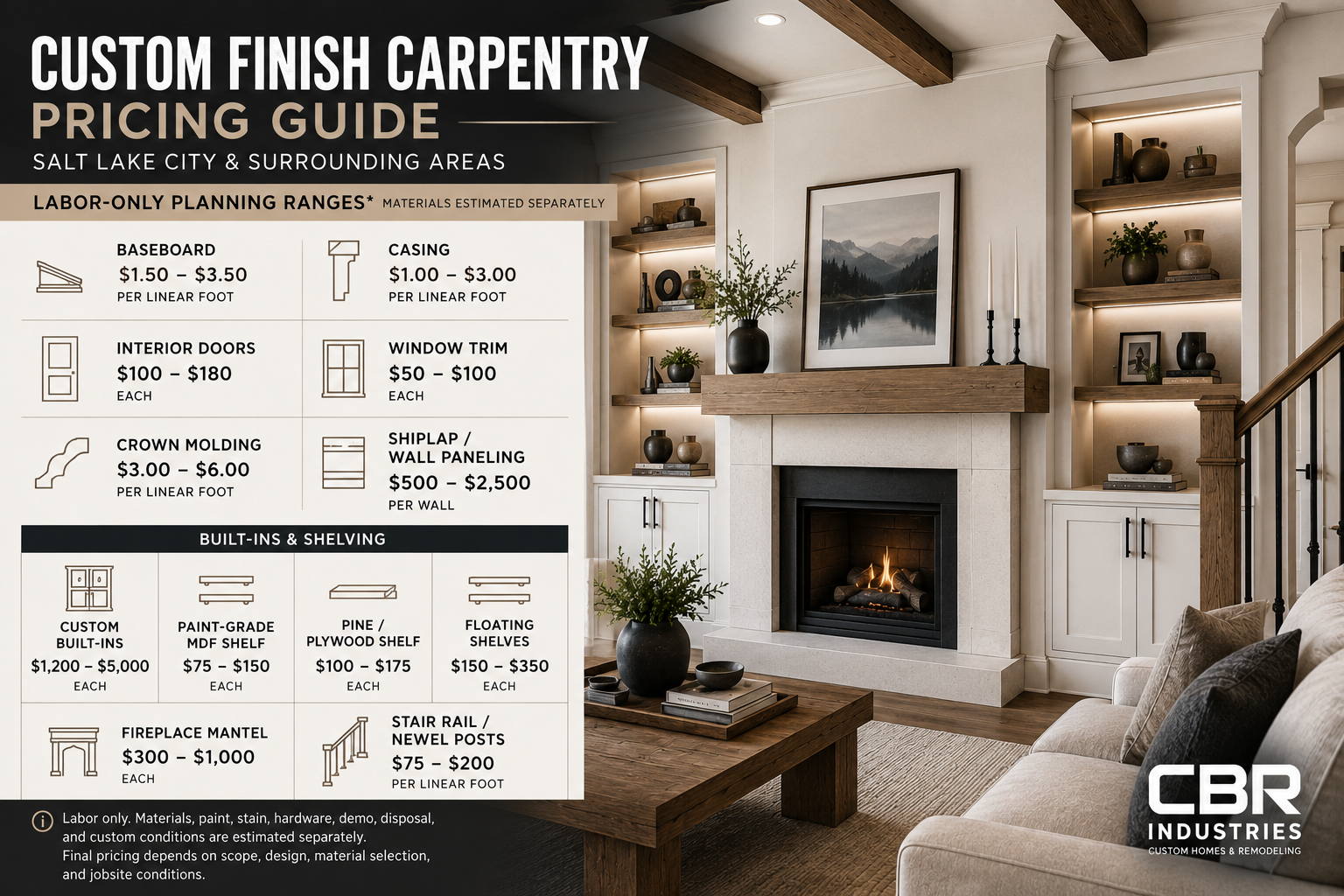
These ranges are based on the CBR Industries quick estimate calculator and should be treated as labor-only planning ranges. Materials are estimated separately.
These are not guaranteed final prices. They are starting points to help homeowners understand what different types of finish carpentry can cost before getting a real quote.
Basic Trim Work
Basic trim work usually includes baseboard, casing, window trim, and interior doors.
ItemLabor-only planning rangeBaseboard$1.50 to $3.50 per linear footCasing$1.00 to $3.00 per linear footInterior doors$100 to $180 eachWindow trim$50 to $100 each
The lower end usually fits simpler installs with clean conditions and basic material.
The higher end usually comes into play when there are more corners, more detail, harder conditions, tighter expectations, or extra layout involved.
Crown Molding
Crown molding is usually more involved than basic baseboard or casing because the cuts and angles are less forgiving.
ItemLabor-only planning rangeCrown molding$3.00 to $6.00 per linear foot
Crown can cost more when the profile is larger, the ceiling is uneven, the walls are out of square, or the room has a lot of corners.
This is one of those jobs where cheap work shows fast. If the corners are bad, everyone sees it.
Shiplap and Wall Paneling
Wall paneling can be simple or it can become very detailed depending on the design.
ItemLabor-only planning rangeShiplap / wall paneling$500 to $2,500 per wall
A small, simple wall is one thing.
A full feature wall with picture-frame boxes, stair transitions, tall ceilings, multiple planes, or custom spacing is a different project.
The time is not just in cutting boards. The time is in making the layout look right.
Custom Built-Ins and Shelving
Built-ins are where finish carpentry starts moving closer to custom woodworking.
They usually take more planning, material handling, fitting, and detail than basic trim.
ItemLabor-only planning rangeCustom built-ins$1,200 to $5,000 eachPaint-grade MDF shelf$75 to $150 eachPine / plywood shelf$100 to $175 eachFloating shelves$150 to $350 each
A single shelf and a full built-in are not the same thing.
A built-in might include face frames, panels, trim, storage, doors, drawers, hardware, and custom fitting to the wall. That is why built-ins need to be looked at as a full project, not just a piece of wood on the wall.
Fireplace Mantels
A mantel can be simple, or it can be part of a much bigger fireplace build.
ItemLabor-only planning rangeMantel install$300 to $1,000 each
If the project includes a full fireplace surround, side built-ins, paneling, tile coordination, hardwood details, or custom design work, it should be priced separately.
A mantel install and a full fireplace feature wall are not the same scope.
Stair Rail and Newel Posts
Stair work takes more care because it has to be solid, clean, and properly laid out.
ItemLabor-only planning rangeStair rail / newel posts$75 to $200 per linear foot
This is not an area where I would recommend chasing the cheapest number.
Stair rail work needs to feel solid. It also needs to look clean because it is usually in a very visible part of the home.
Why These Prices Are Labor-Only
This part matters.
Material is separate because material choices can change the price fast.
A paint-grade MDF shelf is not the same as a hardwood shelf. Basic casing is not the same as stain-grade trim. A simple mantel is not the same as a custom hardwood fireplace surround.
Labor-only pricing helps give a starting point, but the final project price may also include:
Material
Hardware
Paint or stain
Demo
Disposal
Delivery
Design changes
Repairs
Unusual jobsite conditions
Travel
Extra protection for occupied homes
That is why a real estimate needs to be based on the actual space.
A calculator can give you a starting point. It cannot see your walls.
Where Cheap Bids Usually Cut Corners
A cheap bid is not always bad.
Sometimes a job is simple. Sometimes someone has a better schedule. Sometimes the lower number is still fair.
But with finish carpentry, cheap work can get expensive if it has to be fixed later.
The corners usually get cut in places like:
Layout
Material quality
Consistent reveals
Proper fastening
Clean miters
Clean returns
Matching existing trim
Sanding and prep
Protecting finished areas
Taking time to deal with bad walls or floors
This is where homeowners need to be careful.
The cheapest bid might still get wood on the wall. The question is whether it will look right when the room is finished.
There is a big difference between “done” and “done right.”
What Details Matter Most in a Finished Home
Most homeowners notice finish carpentry in two ways.
First, they notice the obvious features.
Things like:
Accent walls
Built-ins
Fireplace mantels
Mudroom benches
Ceiling beams
Floating shelves
Stair rail
Second, they notice the overall feel of the room.
They may not know why the room feels better, but they can tell when the lines are clean, the trim fits the space, and the details make sense.
The details that matter most are:
Proportion
Symmetry
Reveal consistency
Straight lines
Clean corners
Good material choices
Proper scale
Clean transitions into existing finishes
This is especially true in a lot of Salt Lake Valley homes where people want to take a basic or builder-grade space and make it feel more custom.
You do not always need to rebuild the whole room.
Sometimes the right trim detail, wall design, bench, mantel, or built-in can change the entire space.
But it has to be laid out right.
When Custom Finish Work Is Worth It
Custom finish carpentry is usually worth it when it improves how the space looks, works, or feels.
Good examples are:
A blank wall that needs character
A fireplace that looks unfinished
A closet that does not function well
A mudroom that needs storage
A basement that feels plain
A new build that needs more detail
A main living area that needs a focal point
That does not mean every wall needs trim.
Not every room needs an accent wall. Not every closet needs to be fully custom. Not every project needs to be overbuilt.
A better approach is to pick the areas that will actually matter and do them right.
A well-built feature in the right spot will usually do more for a home than a bunch of small upgrades spread everywhere with no plan.
How to Get a Better Estimate
If you want a better estimate, give better information.
Before reaching out, try to have:
Photos of the space
Rough measurements
Inspiration pictures
A basic idea of what you want
Whether you want paint-grade or stain-grade
Whether you want material included
Whether painting or staining needs to be included
Your rough timeline
Any known problems with the space
You do not need to have every detail figured out.
But the more information you give up front, the easier it is to tell whether the project is simple, detailed, or something that needs an in-person walkthrough.
If you are comparing bids, make sure you are comparing the same scope.
One bid might include material. Another might not.
One bid might include demo. Another might not.
One bid might include a cleaner finish level. Another might just be a basic install.
Those are not the same estimate.
Final Thoughts
Custom finish carpentry costs in Salt Lake City can vary because the work itself varies.
A baseboard install, a crown molding project, a wall paneling job, a floating shelf, a fireplace mantel, and a custom built-in are all different scopes of work.
The better question is not just:
“How much does finish carpentry cost?”
The better question is:
“What am I getting for that price?”
A good finish carpenter should bring layout, clean installation, material knowledge, problem-solving, and attention to detail.
The finished work should look like it belongs in the home. Not like it was forced in. Not like it was rushed. Not like someone just nailed wood up because it was on the plan.
Finish carpentry is one of the last things people see in a home, and it has a lot to do with how finished that home actually feels.
If you are planning a finish carpentry project in Salt Lake City or the surrounding valley, start with photos, rough measurements, and a clear idea of what you want the space to become.
From there, a real estimate can be built around your actual home, not a random number from the internet.
Call to Action
Planning a custom finish carpentry project in the Salt Lake Valley?
Send CBR Industries a few photos, rough measurements, and what you want the finished space to look like. Whether it is baseboard, casing, crown molding, wall paneling, floating shelves, a fireplace mantel, stair rail, or a custom built-in, we can help you understand what is realistic before you spend money in the wrong place.
Request a finish carpentry estimate today.